

How Abby Scott became a legend, a documentary subject, and the role model her community always needed.
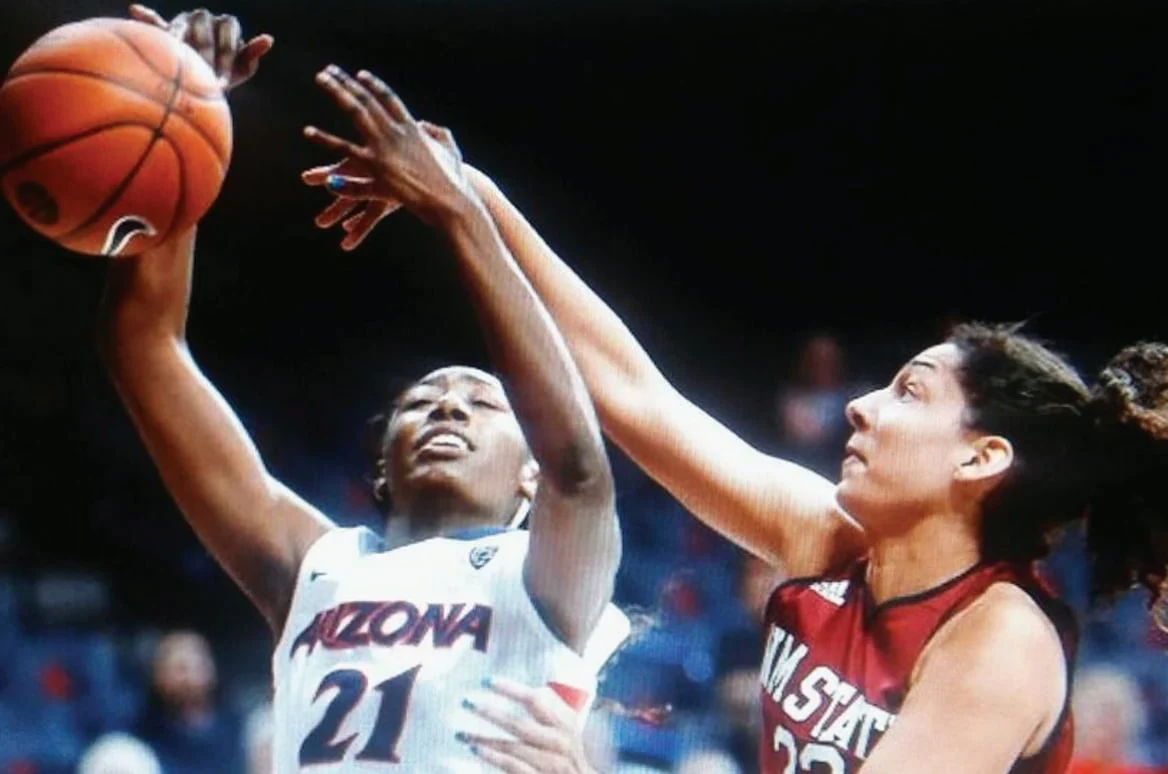
The lights go down at the Portland Film Festival. On the screen, a young woman in a New Mexico State uniform rises above the defense, releases, and watches the ball arc through the air.
The crowd in the theater doesn’t know yet what the crowd in that gymnasium already knew: that Abigail Scott, girl from the Warm Springs Reservation doesn’t miss shots like that.
Not at the buzzer. Not when it matters most.
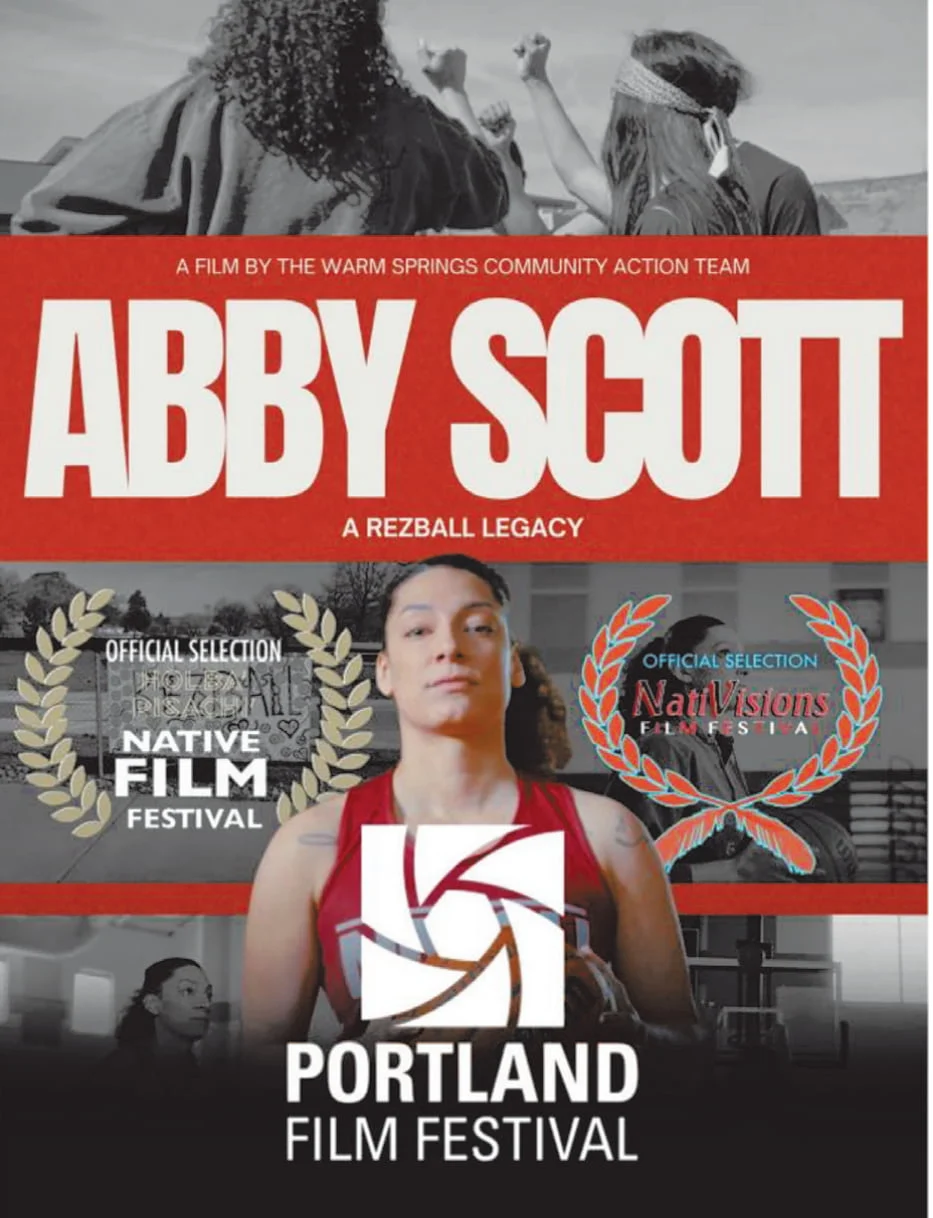
The film is called Abby Scott: A Rezball Legacy, directed and shot by LaRonn Katchia through the Filming with an Indigenous Lens Documentary Workshop—a program Katchia created with Brutis Baez to empower Native communities to tell their own stories.
Edited, colored, and sound-designed by Simone Scarpino, the film was produced by the Warm Springs Community Action Team.
By the time it reached the Portland Film Festival—after earning Official Selection honors at the Holba Pisach Native Film Festival and the NatiVisions Film Festival—audiences across the Pacific Northwest had begun to understand something that the people of Jefferson County, Oregon had known for years.
Abby Scott’s story isn’t just a basketball story.
It’s a story about what it means to come from somewhere. And what it means to go back.
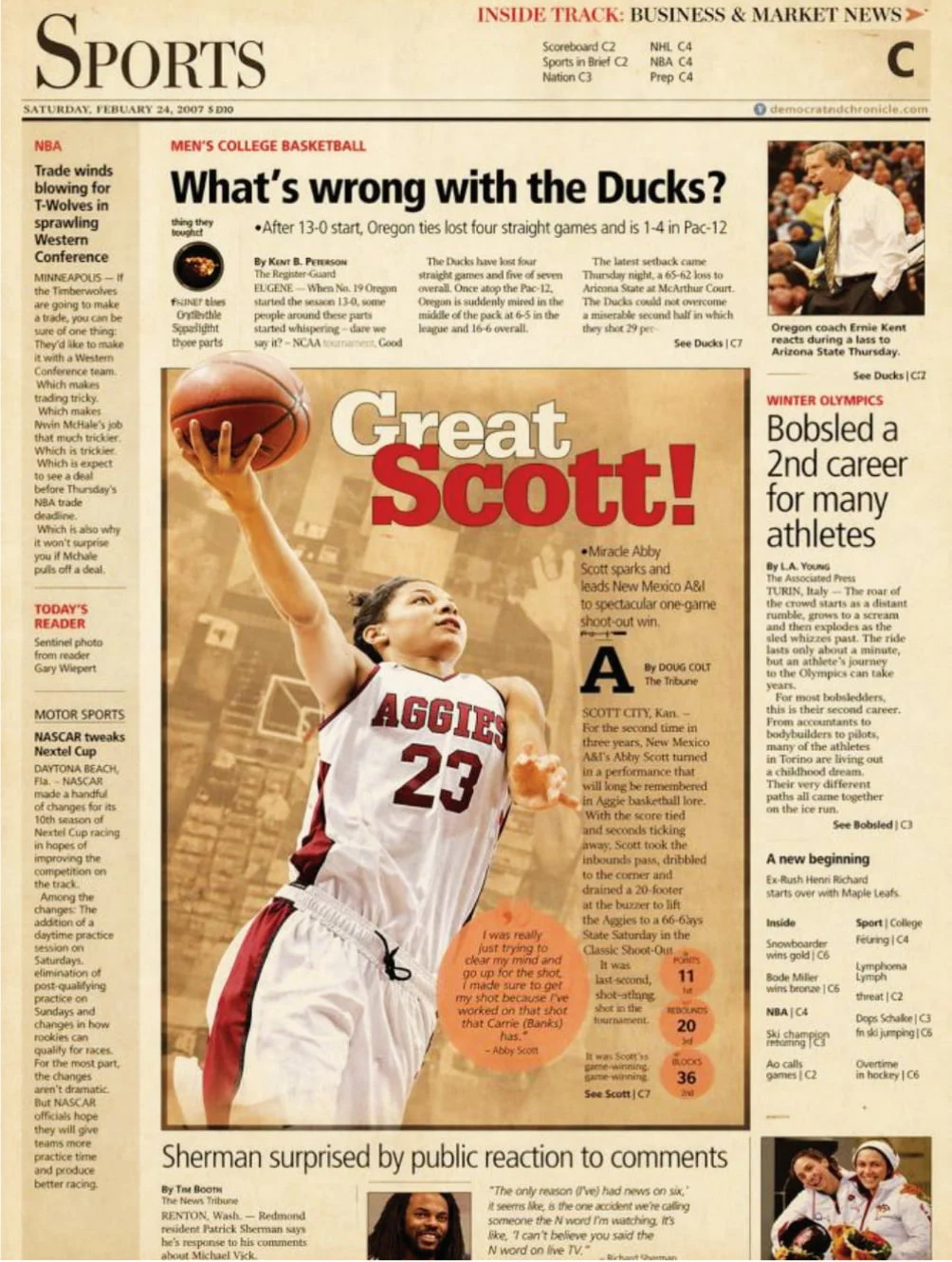
On a February night in Scott City, Kansas, with the score tied and seconds dissolving off the clock, Abby Scott took an inbounds pass, dribbled to the corner, and drained a 20-footer at the buzzer to lift the New Mexico State Aggies to a 66-65 victory in the Classic Shoot-Out.
It was the second time in three years she had done something like this for the Aggies. The local newspaper ran her photo on the front page of the sports section under a headline that said everything and needed nothing else: ‘Great Scott.’
Great Scott
“I was really just trying to clear my mind and go up for the shot,” Abby said afterward. “I made sure to get my shot because I’ve worked on that shot that Carrie Banks has.”
Modest words from a player who was anything but ordinary. That same sophomore season, on January 16, Abby walked into a game against Chicago State and did something no player in the history of the Western Athletic Conference had ever done: she made 11 three-pointers in a single game—on 20 attempts—finishing with 36 points and 4 assists. It broke the WAC Conference record. It broke the New Mexico State program record. It earned her WAC Player of the Week honors. Two days later, still in the same week, she dropped 25 more in a win over Kansas City.
Those numbers belong in a highlight reel. What they don’t capture is where they came from.
Rezball
To understand Abby Scott, you have to understand Rezball.
Basketball on Native American reservations is more than a sport. It is ritual, identity, aspiration, and release—all compressed into 94 feet of hardwood.
On the Warm Springs Reservation, where Abby grew up as a member of the Confederated Tribes of Warm Springs, the game was woven into the fabric of daily life. You learned it young. You played it everywhere. And if you were good—really good—the whole community knew your name before you were old enough to drive.
Abby was that good.
By the time she reached Madras High School and pulled on a White Buffaloes jersey, it was already clear she was something special.
As a freshman, she was turning heads at the varsity level. By her junior year, she was averaging 12.2 points, 5.6 rebounds, 3.8 assists and 2.6 steals per game, helping lead Madras to a 21-8 record and a trip to the Oregon 4A State Semifinals—earning First Team All-Tri-Valley Conference and All-State Second Team honors in the process.
Then came her senior season. The one people in Jefferson County still talk about.
She averaged 22.4 points, 8.9 rebounds, 3.0 assists, and 3.3 steals per game. She led Madras to a 25-3 record, the Tri-Valley Conference championship, and a second consecutive Oregon 4A State Semifinals appearance.
In one February 2012 game against Seaside, she dropped 37 points. She was named Class 4A All-State First Team, Oregon State Championship Tournament First Team, and Tri-Valley Conference Player of the Year. And before the season was over, she was nominated for the McDonald’s All-American Game—one of the most prestigious recognitions in high school basketball.
ESPN’s HoopGurlz recruiting website ranked her the No. 38 wing player in the entire country. Scholarship offers arrived from Oregon State, San Diego State, SMU, Pepperdine, University of San Francisco, Santa Clara, Portland, and Utah State.
She chose New Mexico State University, signing with Coach Mark Trakh’s Aggies in the fall 2011 early signing period. Her recruiting class—Abby, Sasha Weber, and Shay Young—was ranked among the Top 20 mid-major recruiting classes in the nation by ESPN HoopGurlz.
The Aggie years
Over four seasons in Las Cruces, Abby appeared in 119 career games for New Mexico State, averaging 6.8 points, 2.1 rebounds, and 1.0 assists per game while shooting 78 percent from the free-throw line. She finished her career among the program’s all-time leaders in made three-pointers—144 career threes—ranking 8th on the all-time list when she graduated. She was ranked nationally in the top 10 percent for blocked shots and blocks per game.
She played in the NCAA Tournament twice, in 2015 and 2016, helping the Aggies claim two WAC regular-season championships and two WAC tournament championships.
In 2017, she graduated with a degree in Individualized Studies.
Senior Night at New Mexico State was the kind of evening that reminds you why college sports matter beyond the stats and standings.
The Pan American Center crowd honored a player who had given them buzzer-beaters, record books rewritten, and four years of watching a girl from the Warm Springs Reservation compete at the highest level of the college game. NDN Sports—the nation’s leading platform for Native American athletics and a longtime chronicler of Abby’s career—was there to mark the moment. Their tribute was characteristically direct:
Then came the harder question. The one every athlete faces when the final buzzer sounds on their playing career: Who am I now, and where do I go?
For some, the answer takes years. For Abby Scott, the answer had probably been inside her all along. She just needed a little road before she could find her way home.
The road home
She didn’t go straight back to Oregon. First came a stint as Recreation Department Supervisor for the Arikara, Hidatsa and Mandan Tribal Nation in Newtown, North Dakota—leading youth basketball programs, designing fitness activities, investing in the lives of young Native people in another corner of the country. Then came a position as Recreation Department Leader for the Hoopa Valley Tribe in Hoopa, California, doing the same.
She was good at it. She understood these kids in a way that outsiders couldn’t easily learn. She knew what it felt like to be a young Native person who needed to see someone who looked like you doing extraordinary things. She had been that kid once, searching for that mirror.
But the pull of home—of the reservation, of the community that had raised her, of the mountain air and the high desert and the hallways of the school where she had first learned to dream big—was stronger than she could resist.
In 2019, Abby Scott walked into the Warm Springs k-8 Academy as a Special Education teacher.
She had come full circle.
The hallway
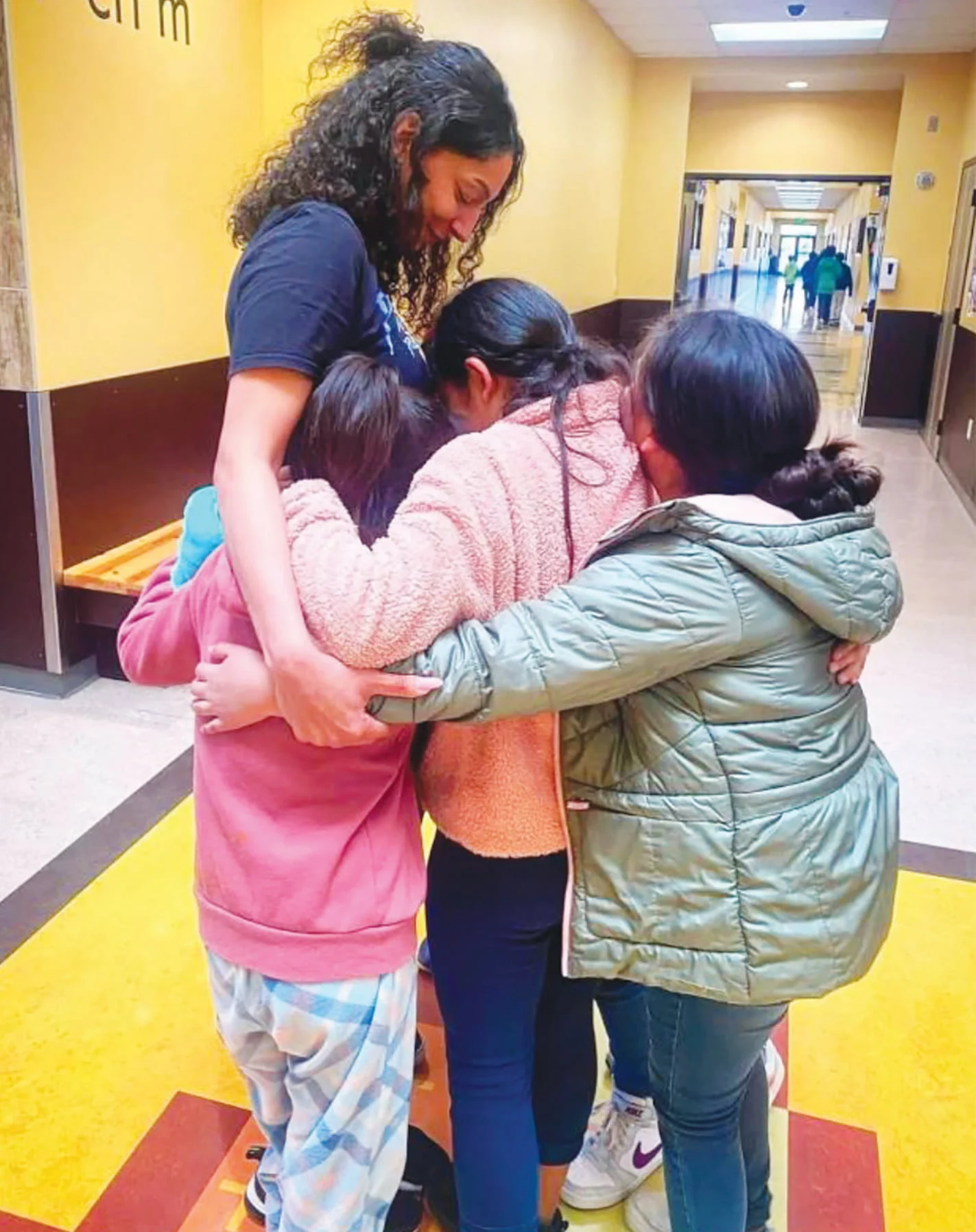
There is a photograph that captures something no résumé can adequately describe.
Abby Scott stands in a school hallway—the hallway of Warm Springs Academy, the very reservation school where she once walked as a student. She is tall, unmistakable, her curly hair pulled back. And she is surrounded by children—small arms reaching around her, heads tucked in against her, a tangle of kids who simply do not want to let go.
She is laughing. Or something very close to it. The kind of smile that only comes when you know—in the marrow of your bones—that you are exactly where you are supposed to be.
Brian Gallagher has taught at Warm Springs since 1994. He had Abby in his third-grade class. Decades later, he watched her walk those same halls as a colleague, and wrote about it with the plain certainty of a man who has seen a lot and knows the real thing when it crosses his path.
“Abby is one of those people whom you will never forget once you meet her,” he wrote. “Not a day goes by that I don’t see her in the hallway connecting with any grade level of student who smile and visibly brighten up when they see her.”
“She knows what it is like to face the obstacles our Native students face and how to persevere through those obstacles and to not only succeed but to be successful in a way that most people only dream of achieving. We need people like her to be in our schools and communities to model and demonstrate what any person can achieve—especially our native students.”
A rezball legacy
In 2022, Abby transitioned to Madras High School—the same school where she had averaged 22 points a game and earned a Division I scholarship. Now she teaches Special Education there, and she serves as Assistant Girls Basketball Coach for the White Buffaloes.
The players she coaches may not know every detail of her story yet—the WAC records, the buzzer-beaters, the film festivals, the packed arenas. But they know her. They see her every day. And for the Native girls among them, especially those who wonder whether a big world exists beyond the reservation borders, she is living proof that it does—and that reaching it doesn’t have to mean leaving yourself behind.
The documentary that bears her name—Abby Scott: A Rezball Legacy—has now screened at three major film festivals, carried into theaters by the Warm Springs Community Action Team as a statement of cultural pride and an act of preservation.
Director LaRonn Katchia, a filmmaker deeply rooted in Indigenous storytelling, built the film through his Filming with an Indigenous Lens workshop — a program designed so that Native communities don’t just appear in documentaries, but make them. The film was edited, colored, and sound-designed by Simone Scarpino, whose work brings Abby’s story to life with quiet power and precision.
This woman’s story matters. This community’s story matters. Rezball matters.
It matters because of what it produces. Not just athletes—though it produces extraordinary ones. It produces people who know how to compete when the odds are stacked against them. People who know how to rise when the clock is running out. People who know how to come home.
Abby Scott scored 36 points in a single college game on the strength of 11 three-pointers. She hit a buzzer-beater in Kansas that put her on the front page of a newspaper. She earned scholarship offers from programs across the country and played on the same floor as Maryland in the NCAA Tournament.
And then she went back to Warm Springs. Back to Madras. Back to the hallway where the kids can’t stop hugging her.
Some people spend their whole lives chasing legacy.
Abby Scott just went home and became one.
Abby Scott: A Rezball Legacy was directed by LaRonn Katchia, edited and sound-designed by Simone Scarpino, and produced by the Warm Springs Community Action Team through the Filming with an Indigenous Lens Documentary Workshop.
The film is an Official Selection of the Portland Film Festival, the NatiVisions Film Festival, and the Holba Pisach Native Film Festival.